

My Burnout Story — and Why It Was Never Just About Me
Late-stage capitalism, patriarchy, and white supremacy don’t just shape policy. They shape our daily lives.

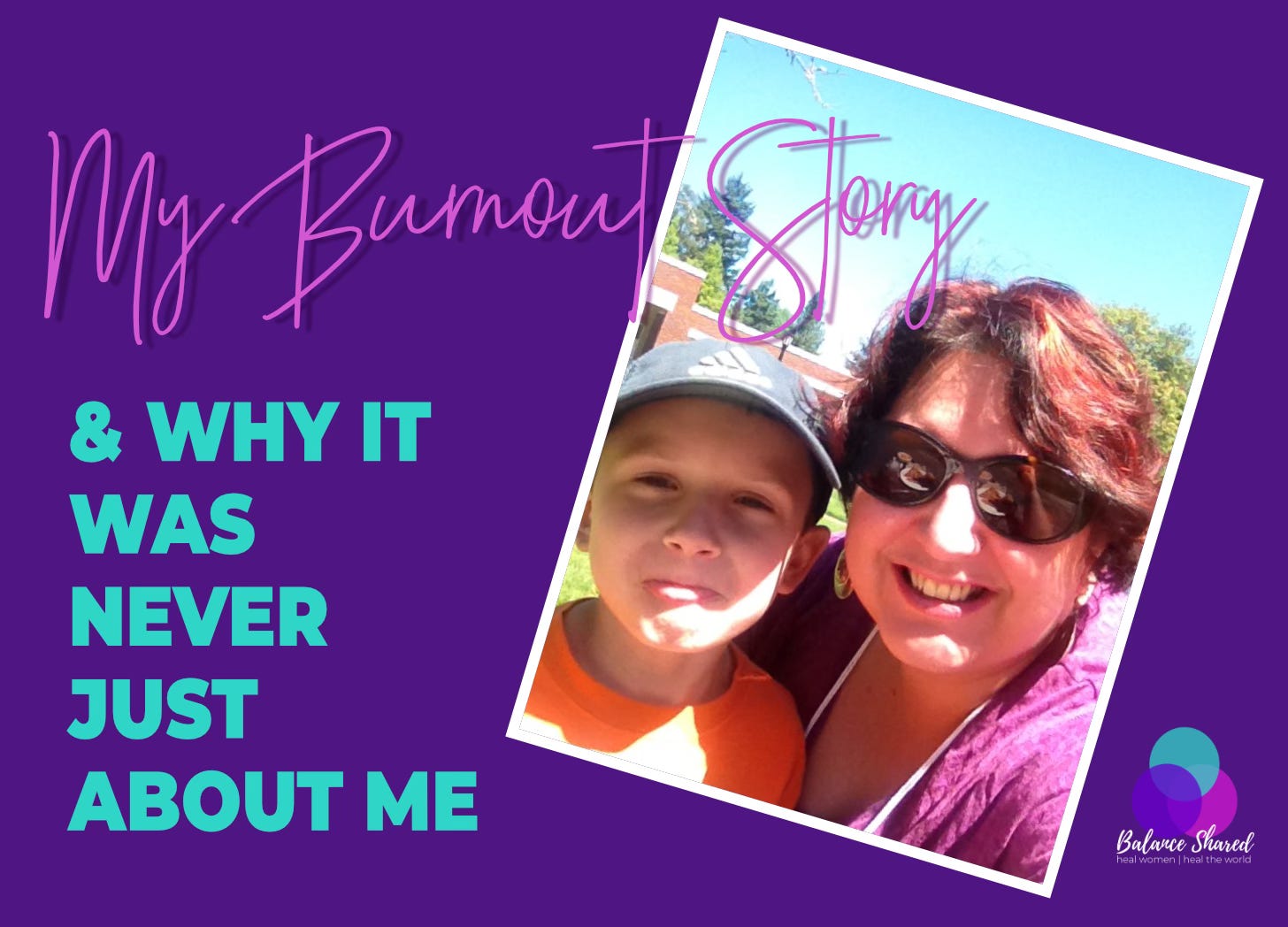
The time when my son was in 1st and 2nd grade has forced the focus I want to take in this world - learning how to say “No” and choosing what’s really aligned for each of us. I was working full time, keeping the house as well as I could, part-time, and making sure my son got to all the activities that were ripe for his development, part-time.
A day in the life of my life 12 years ago looked like this. I woke up tired, dragged the kid out of bed, negotiated breakfast, and prayed there were clean clothes. I fought to get him to school while managing my own rising anxiety. I worked all day with the clock ticking because it was soccer night, which meant I had to leave early, endure traffic, and participate in more negotiation because the kid doesn’t want to go. He cries, I guide. And when we get there? He refused to participate, and somehow I still managed to smile. We get home after 7, hungry and worn down, wondering how this became normal.
I’m exhausted just trying to remember these events.
And I wasn’t alone. Versions of this story play out again and again in households like mine. I made these choices because I felt stuck. I had to work to contribute to the family and pay back my student loans. Did I mention I wasn’t even working in a field I had studied directly for? But this was on the heels of the 2008–2010 recession, and I took the only job that said, “Will you work for us?” On my salary alone, covering housing and tuition wouldn’t have been possible — being in a two-income household made it work. So we were just getting by, paycheck to paycheck, in a dual-income household with one kid.
So many of us tell ourselves, “If only we planned better… I could just get it together…”
Seriously?
The schedule we lived by was impossible.
I later found out the boss at the time was asking other employees, not me, why I was always leaving early. So, in the midst of trying to stay in control, keep it all together, I got another clue to the stressful work environment I was in.
During this time, my husband worked nights — which meant he needed to sleep during the day and was gone most evenings. The logistics of that schedule left me holding most of the parenting responsibilities, even though we were a two-parent household. I love my son deeply, and I’ve always been committed to supporting him in this world. And still, I often found myself wondering: what would it have looked like if the care work had been truly shared?
We live in a patriarchal world shaped by late-stage capitalism — and it shows up in our homes as much as it does in our policies. The invisible labor that keeps households running too often goes unseen, especially when traditional gender roles are still quietly at play. As Zawn over at Liberated Motherhood says, “If he wanted to, he would.” But I was — and still am — in it, and I didn’t see a clear way out. The job I had was the one that said yes when I needed it most, and while I kept scanning for what might come next, nothing workable showed up. To cover tuition and bills, I needed full-time hours — and there was no obvious part-time option that could have met that need.
So I felt stuck.
12 years ago, I was feeling the burnout. I was and am a full-time mother. I took care of the house. And, I worked full-time. I had no immediate support network that I could turn to. I internalized this as a “me” problem. I couldn’t figure this out.
But there are so many people who feel the same way. If so many of us feel the same way, it ceases to be a “me” problem. When we all feel the same exhaustion, lack of choice, and more — it’s a systemic problem. We have a choice, though. When we notice these feelings, whether we recognize they are part of a system or not, we have a choice to bring in our own agency. Burnout is a sign that something is wrong, and what we do with it is what matters. We can even employ our agency to recognize that we are in burnout and we don’t like it, even if we don’t have an immediate solution.
Let’s ground ourselves — remember that capitalism requires endless growth. But, at the same time, it’s rooted in scarcity. That dualism in and of itself is exhausting. Patriarchy demands so much emotional labor of women, especially mothers. White supremacy is an extractive system that rewards dominance, which depletes care.
These forces are all connected — they shape our time, our energy, and even how we relate to care.
We need to get to the third way, and that gets complicated when even our systems of care are co-opted. Genuine community care and mutual aid are rooted in interdependence and dignity. And, still, many charity models replicate the same power dynamics they should be disrupting. They enforce rules, judgment, and even dependency. Care in this way is conditional, or it’s filtered through control. Which really means — it’s not care at all, it’s control with a smile.
We are faced with the false binary: either hustle or collapse. Either succeed or disengage. I wrote about the Third Way last week. This is a space where we recognize that extreme isn’t the answer. We must build new systems, new rhythms, and new ways of being.

There is so much happening right now. I keep getting caught in the false question of, “How do I fix this myself?” But, what happened if I/we reframed it to, “What am I being asked to carry that’s not mine?”
We must reclaim rhythm. We must reclaim rest. We must reclaim collective pauses. We absolutely must reclaim setting boundaries.
(If you need a tool, I’m relaunching both my moon circles and my moon deck. You can get on their respective waitlists (moon circles/moon deck)).
Let’s take a bit of solace that burnout is evidence that we are alive. And, we are alive in a system that asks too much, and it gives us too little. So, you are not broken. You are responding appropriately to structural harm.
We don’t have to build a house there. We can build another way.
All it takes is (1) recognizing we can and (2) saying no to that which we don’t need to carry. Then, we slowly build the third way, but we do it, together.