

Uninterrupted Time Is a Privilege
Creative freedom follows power — and power has never been evenly distributed

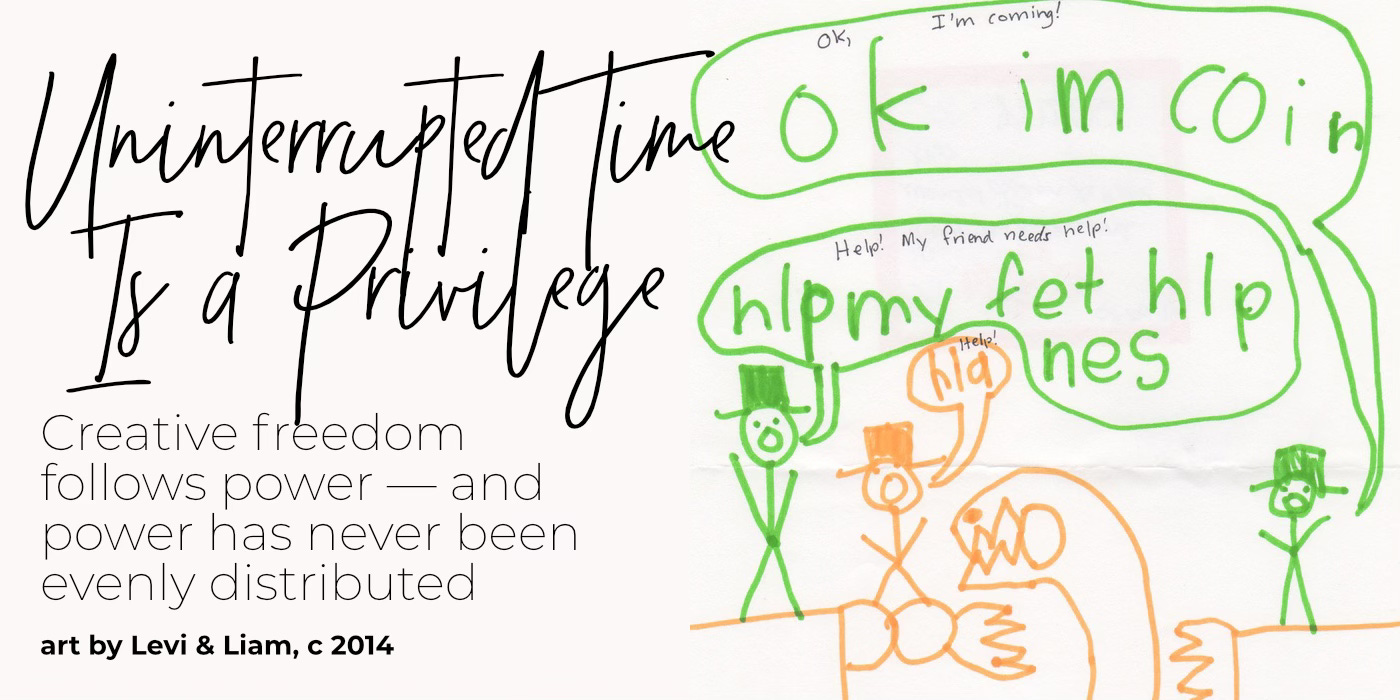
I love art.
I wish I could draw and write every day — and earn a living doing it. And, in that tension, I am also very privileged to do the organizing work I do day to day. I remind myself, we can hold multiple truths. I can love my job and wish my schedule had more freedom to do the other things I love.
The challenge with my job-job, as I affectionately call it, is that by the end of the day I am so tired. We have so many Zoom meetings where we are sharing ideas, coaching, and strategizing; but then there is the work that needs to be done.
I am an introvert. I get my energy in the time away from people, no matter how much I enjoy and love people.
So, the day extends beyond a traditional work day in order to get all the things done. For example, at the time of this writing, I took a break after the last meeting to make dinner because it was dinner time. That means, I was working from 9am through 5:30pm. I “took a break to make dinner,” and then went back to the work computer to finish only some of the tasks on my daily list I wasn’t able to get to during all the meetings.
But, what about me? What about the fun I want to have? So, after I got as much work done in a 10+ hour day, I pulled out the personal computer to have fun creating. Again, at the time of this writing, to allow that free unfettered creative thinking space, time moved passed a reasonable bedtime into the wee hours (after midnight).
So, I sit in this tension of wanting to create, from the heart, and feeling like I can only do it if things get sacrificed. And, what got sacrificed when drafting this was sleep. Sleep restores the body and the mind. The ability to create. So, the question begs, who gets to create without interrupted time?
These past few months, I’ve found myself wandering through the museum. In the most recent wandering, the husband and I examined the David Hockney exhibit that the Art Museum has on full display.
A wealthy, local capitalist is sharing his collection for museum goers, and it’s extensive. Prints — done by hand and by iPad, spanning decades.
I first heard of Hockney through Ted Lasso where the character, Rebecca, was callously throwing away a $2 million print because it belonged to her ex, Rupert. There is a tidy homage to Hockney, where at the end of the show she acquires a different piece. Art as healing.
This British artist, Hockney, was able to make it. He’s still alive! And, what it looks like — knowing these pieces — his work can sell for millions now, and he was on the forefront of iPad creation… he gets to play in his art now.
And, I’d be remiss if I didn’t admit that I am jealous.
In that jealousy sprouts curiosity — who gets to create for their living and who doesn’t?
This reflection brings back the most memorable woman artist I studied in school: Mary Cassatt, who created art in the late 1800s. She painted mostly women and children. In my survey class, she was only given a nod of appreciation to the art she created. Art that absolutely rivaled the artists of her time in talent, composition, and technique. I get curious, why was Cassatt the only woman painter we looked at? Additionally, where were the artists of different ethnicities? We were so focused on Euro-centric people.
I also get curious about the women authors who had male pen names so they could get published, like Jane Austen and Charlotte Bronte.
And, I get curious about artists like Van Gogh who were so talented but, “before their time”.
Who gets published? Recognized? Shown? And who doesn’t?
In this reflection, I also think of the book I can’t finish — Deep Work by Cal Newport. Modern authors, authors of 150-200 years ago. Artists now, and artists of centuries past. Who are we propping up, and who never gets their work shown?
In Deep Work, Newport argues that if you could just focus long enough on a task, you could accomplish great things.
I would love uninterrupted time. I would love the time to let my brain refresh. I would love the time to amble along on a painting or a sketch or a written piece. But, I solely operate in interrupted time.
Newport’s assertion that uninterrupted time, deep work, is the only way to accomplish great work pisses me off because clearly he comes from privilege. He framed uninterrupted time as a personal virtue rather than a structural advantage — the kind of structural advantage scaffolded by domestic labor, economic stability, and often the unpaid work of women.
Productivity culture often mistakes insulation for discipline. The gift of uninterrupted time is treated as gospel without acknowledging the structures that make it work. And, the coach who recommended it had the same challenge.
And, it pissed me off. They buried the lede. They used manipulation as a tool to shame people for not having it all — you just didn’t focus enough.
And, a little of that gets brought up when I see how much work Hockney was able to create and get paid for it.
My time is spent doing domestic labor, it is fragmented by caregiving, it has been fraught with financial instability, and my mental space is occupied by survival and pockets of rest. Which makes it really hard to just create.
Between Newport and Hockney, it seems they both had a precious resource at their disposal: uninterrupted time. Cassat’s imagery is enmeshed in caregiving. So, she wove her observations with her art.
Regardless, uninterrupted time is a privilege. And, we have to name it.
Also, let’s not bury the lede. Uninterrupted time is not randomly distributed. It follows power. And power in this country has been structured by racism and sexism from the beginning. This is why we studied Euro-centric artists, for example, in my art history classes.
Understanding who gets uninterrupted time and who does not is essential if we want to change the terms of the social contract we were born into. When we see the racist and sexist roots, we can’t ignore them. We have a responsibility to name them and dismantle them.
We live in a system that equates worth with productivity. It rations creative oxygen. It treats art as a luxury unless it is monetized — and only a few people can monetize their art. It moralizes hustle, which makes rest elusive.
The social contract we live in right now says you trade your hours for survival. And, it’s hard to create when there are so few hours left.
Here’s the thing — we can admire the beauty that Hockney and van Gogh recreated. But admiring the ability of Hockney to create really interesting works and get paid without acknowledging the system that lets him do that is an incomplete observation of our world.
So, I get curious — what would it look like to distribute time in a way that everyone who wanted creative flows had access to it in the way they wanted? What supports would our world have to have that was so natural we never questioned it? So that every mother, father, sister, brother, auntie, uncle, everyone in between — no matter how abled they are or their children — anyone who wanted to create — just could.
I believe we could all create when we wanted if systems of support were in place that centered care work. With care at the center, child care would be freely available and ruled by family choice. Health care would be a given because we’d focus on taking care of the young, the old, and those who need extra care, whereby everyone in between would also get what they need. When we create the world we want, rooted in care, guaranteed income and basic standards of living (not being houseless!) would be the norm. And as such, public art would be a norm we could all enjoy.
Essentially, I believe we would be much more balanced and in tune with ourselves, the people around us, and the world around us.
And, that, that is the world I want to usher in.
P.S. I’ve been in love with the em dash (—) since the early 2000s when MS Word routinely corrected my dash (-) to an em dash (—). Because I’m old. Also, when this publishes, it will be my birthday. Happy birthday me, here’s to writing creatively.