

Seeing What’s Hidden
A trip last year has me reflect on what we chose to ignore

(Originally written February 10, 2024. And, I still think about these things more than a year later.)
I’m sitting in a cafeteria at Daimler while my child—who turns 17 today—is sequestered in another room with his robotics team. There’s no usual live stream, just a quiet space with locked access to the Willamette Riverfront, a closed coffee shop, and plenty of light. As I wait, my mind keeps circling one idea: what we choose to see and what we ignore.
It came up in different ways over the past few days.
Why do companies still refuse to list pay scales in job postings?
What was that warning sign I saw in a Utah State Capitol bathroom about?
How do we get white people to see and honor “color” instead of pretending race doesn’t matter?
And, of course, it’s my kid’s birthday—which, like everything else, reminds me of time and growth, what changes and what stays unseen.
The Bathroom Sign That Raised Questions
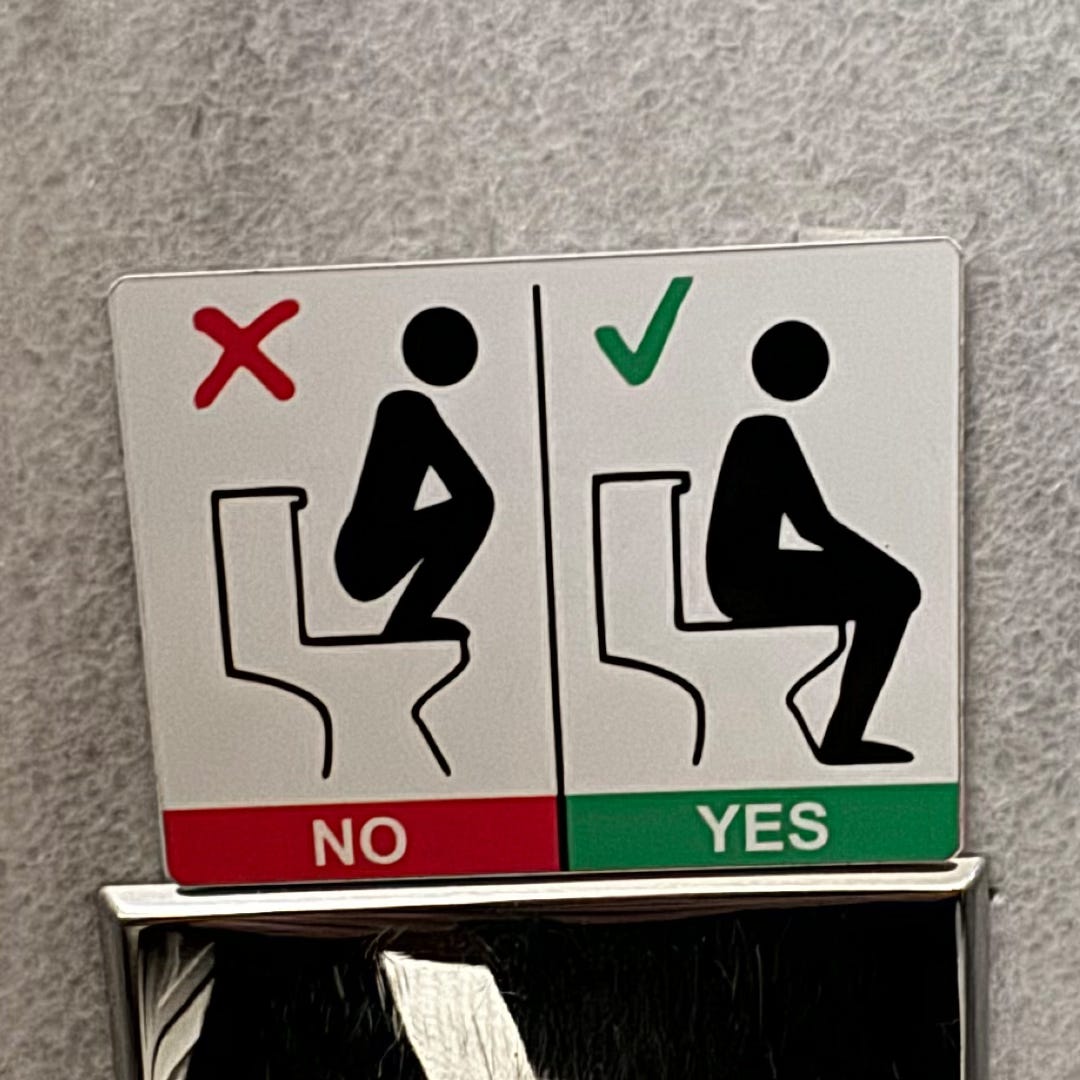
Friday morning, I was in Utah for an advocacy event. At one point, I stepped into a restroom and noticed a sign that left me confused. It showed a figure squatting on a toilet with a warning against it.
I had never seen anything like it before. What exactly was this sign meant to prevent? I sent it to my husband, and his first thought was that it might be a form of bigotry—an assumption about people from other countries. A quick Google search revealed that squat toilets are common in some places, which only raised more questions.1
I’ve been to most of the lower 48 states, and this is the first time I’ve seen a warning like this. Why would the Utah State Capitol have this issue when so many other places don’t? Was this sign based on a real problem or a projection of someone’s biases?
What We See—And Don’t See—About Race
The trip to Utah made me think about visibility in a broader sense. While I was there, someone told me, “Utah doesn’t have a race problem.” That statement stuck with me.
Looking around, I saw mostly white faces in public spaces. At the same time, I also saw Black and Brown people—at the Capitol, at a café, in hotel service roles. My Lyft drivers were all white. The people cleaning hotel rooms spoke Spanish.2
When people say, “We don’t have a race problem,” what they often mean is, “I don’t see race as an issue.” But that doesn’t mean disparities don’t exist. How can everyone be equally represented if one group holds the most power and influence? It’s not just about numbers—it’s about who gets to be seen, heard, and considered when decisions are made.
The Pay Scale Problem
This idea of visibility connects to another issue I’ve been thinking about: pay transparency.
Recently, I saw a job posting for a “coordinator” position. To me, “coordinator” suggests entry-level, yet this city job came with an $80,000 salary. That’s enough for a very modest middle-class life in Portland—covering housing, food, utilities, and maybe a few extras.
But how often do companies hide salary information, forcing people to guess their worth? Just like race, money is another thing people pretend isn’t an issue—until the lack of transparency creates real harm.
The Thread That Connects It All
Whether it’s a bathroom sign that hints at bias, people claiming they “don’t see race,” or job postings that obscure pay, the common thread is the same: what gets acknowledged, and what stays hidden? Who benefits when certain things remain unspoken?
These are the questions I keep coming back to—while waiting for my son, watching him grow, and wondering what we’re teaching the next generation to see more clearly than we do.
JQ. “The One About Japanese Toilets.” This Tiny Planet (blog), August 19, 2015. https://thistinyplanet.wordpress.com/2015/08/19/the-one-about-japanese-toilets/.
The Kem C. Gardner Policy Institute. “Race and Ethnicity Estimates,” February 13, 2023. https://gardner.utah.edu/demographics/population-estimates/race-and-ethnicity/.